Use the Environment to Set Your Dog Up For Success
This blog about strategies for managing mouthing in dogs is the final in a 3-part series. If you missed them, you can read Part I and Part 2. Most interventions aim to limit your dog’s mouthing while also reinforcing behaviors you like. Many people struggle to both prevent mouthing and reinforce appropriate behavior. Here are some ways you can aim for managing mouthing behavior success through your dog’s environment:
- Baby gates or exercise pens: If you have baby-gates or ex-pens around your house, you can step over the gate or step out of the ex-pen when your dog’s mouthing becomes unstoppable. This keeps you safe and also stops their ability to practice mouthing.
This allows you to play with your dog but then leave the situation if they become mouthy. In other words, you can play with them as long as they are being polite, but if they mouth you, then you can safely walk away from them and end the game. If don’t have a way to physical stop them by using a baby gate, ex-pen, or back-tie, you’ll find that most dogs will follow you and continue to mouth on your body. They may even mouth harder as you try to escape! So having a way to physically control them when you escape is ideal. - Back-ties: Use a long rope or a leash to tie your dog to a strong point in your home. For example, tether your dog to a door or a couch with a long line. (Note: This supervised method helps your dog to self-soothe and calm down.)
- Crates: Many dogs who mouth when tired or over-aroused just don’t know how to regulate themselves. Putting your dog in their crate or an ex-pen for a nap can help immensely!
- Only play with well-rested dogs and get ahead of your sleepy dog: If your dog is well-rested and calm, go ahead and play! But if it’s time for your dog to have a nap or your dog had a big day and you know they are likely to be overtired, avoid playing with them. Instead, help them out by getting them set up in their sleeping area so they can nap. This will avoid the mouthing behavior altogether.
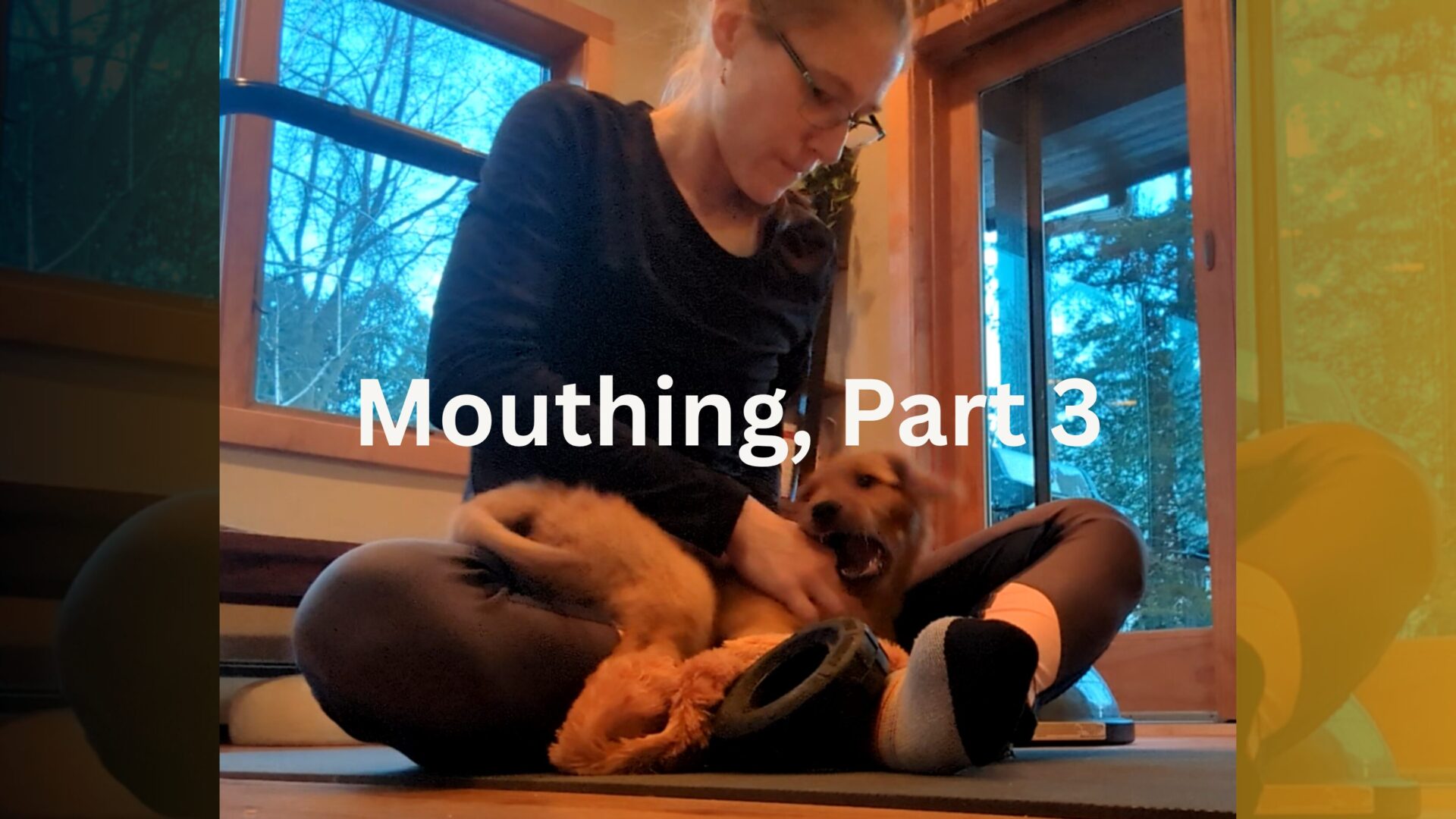
- Have lots of toys out: Not only will this encourage mouthing/chewing on toys, but it gives you some safety if you need to “feed the bite” by popping a toy into their open mouth. For example, my puppy is a golden retriever and always needs something in her mouth or she will find something to put in her mouth (AKA, my hand). So having a bunch of toys out that I can place into her mouth is extremely useful. These toys can be especially useful to “feed the bite” (see below).
- “Feed the Bite”: I learned this from my colleague, Leann Boucha. “Feed the bite” means that you have a toy ready for when your dog tries to mouth you and you strategically place the toy into their mouth so that they mouth on something other than you, which you can then reinforce with petting, praise, or more play. This sets your dog up for a lot of success, because it ensures they learn to mouth the right things and avoids mouthing the wrong things. Plush toys work well for this strategy.
- Don’t put yourself within reach of a dog who will fail: If your dog mouths a lot, think about keeping your body tall and somewhat away from their mouth. This might mean that you don’t play on the ground with them for now, or that you stand up the moment they start to mouth you and ignore all the toys.
🐕 Key takeaway: Management prevents mistakes while your dog learns better habits.

Become a Detective: Find Out Why Your Dog is Mouthing
Your dog is mouthing on you for a reason, and it can be helpful to figure out what that reason is, because that can inform what intervention you use. Some dogs will mouth on you because they want your attention, whereas others actually want to escape a situation.
Some dogs mouth on you because they are overtired and don’t know how to regulate themselves, and others will mouth when they get over-aroused during play. Some dogs mouth when they need something from you (i.e., “Help! I have to go outside to potty!”).
If you can figure out what situations your dog mouths in and why they are mouthing, it can help inform how you approach decreasing the mouthing.
Reasons that can cause mouthing:
- The dog who wants attention
- The dog who is overtired
- The dog who is overstimulated during play
- The dog who is frustrated (often occurs on walks)
- The dog who wants to escape
- The dog who needs something from you (e.g., “let me outside!”)
- Other?
🐕 Key takeaway: When you understand the cause of mouthing, the training solution becomes much clearer.
Put a Behavioral Intervention Plan in Place
Once your dog’s needs are being met and you understand why they mouth, you can start a mouthing behavioral plan. Note: If you are not meeting your dog’s behavioral needs, your behavioral intervention will be less successful.
Typically, intervention plans will include reinforcement and possibly extinction or even moments where you take something fun away if the dog mouths on you. For example, let’s say your dog is mouthing on you because they want attention; what you want to do is figure out what behavior you do like, give attention for that, and also stop reinforcing the mouthing. I had one client who trained their dog to bring a toy over and sit in front of the owners; when the dog did this, she was reinforced with a game or tug; if the dog mouthed on the owner, he ignored that or even walked away.
For dogs who get overtired or overstimulated, try to get ahead of the behavior. Give more naps or downtime for overtired dogs and keep play or excitement lower for dogs who get overstimulated. When your pup is playing nicely, you can keep playing; when they mouth, the play briefly stops until you think they are ready to try again. But give them lots of opportunities to succeed and get reinforced.
If your dog mouths on you when you get home because they are so excited and thought you were never coming back, give them a few minutes to settle before you interact with them.
For dogs who get frustrated while on walks, bring treats to help them feel better about the things that are frustrating them, keep the walks shorter, and try not to walk if they are overtired. For dogs in this category, opportunities to run and play intensely off-leash often decrease mouthing while on-leash.
If your dog is mouthing because he’s trying to escape something, think about whether you can make that experience less challenging for him to reduce mouthing behavior. Maybe what you’re asking for is too difficult or scary – can you somehow make the activity easier or more fun? This may be where you want to involve a professional trainer, as they can help you help your dog build skills which make him more comfortable and confident with what you’re asking of him.
For the dogs who mouth because they need something from you, train them to ask for it in a polite way. For example, if you have a dog who mouths because they have to go potty, can you teach them to ring a bell to be let outside instead?
For dogs who just need something in their mouth, well… give them something to carry in their mouth! And if they get distracted and it falls out, help them put it back in again.
🐕 Key takeaway: Dogs repeat behaviors that work, so make polite behavior work better than mouthing.
Conclusions
Very few people enjoy being mouthed on by their dog, but you have so many great strategies to reduce mouthing behavior. If you’ve tried some of these options on a very consistent basis and aren’t getting the results you want, think about bringing in a professional trainer or behaviorist to help you.
Chances are they will recommend the same strategies, but they will likely be able to tailor them to your unique needs or help you think through how to use them in a way that works for you.
🐕 Key takeaway: With the right outlets, management, and training, most dogs can learn to keep their teeth off people.
Note:
This blog about strategies for managing mouthing in dogs is the final in a 3-part series. If you missed them, you can read Part I and Part 2.
References
Brophey, K. (2022). The Karl Hack. Family Dog Mediation.
Oxley, J. A., Christley, R., & Westgarth, C. (2019). What is a dog bite? Perceptions of UK dog bite victims. Journal of Veterinary Behavior, 29, 40–44.
Waite, M. R., Harman, M. J., & Kodak, T. (2021). Frequency and animal demographics of mouthing behavior in companion dogs in the United States. Learning and Motivation, 74, 101726. Published online by Science Direct.
Wells, D. L. (2004). The influence of toys on the behaviour and welfare of kenneled dogs. Animal Welfare, 13(3), 367–373. Published online by Cambridge University Press.