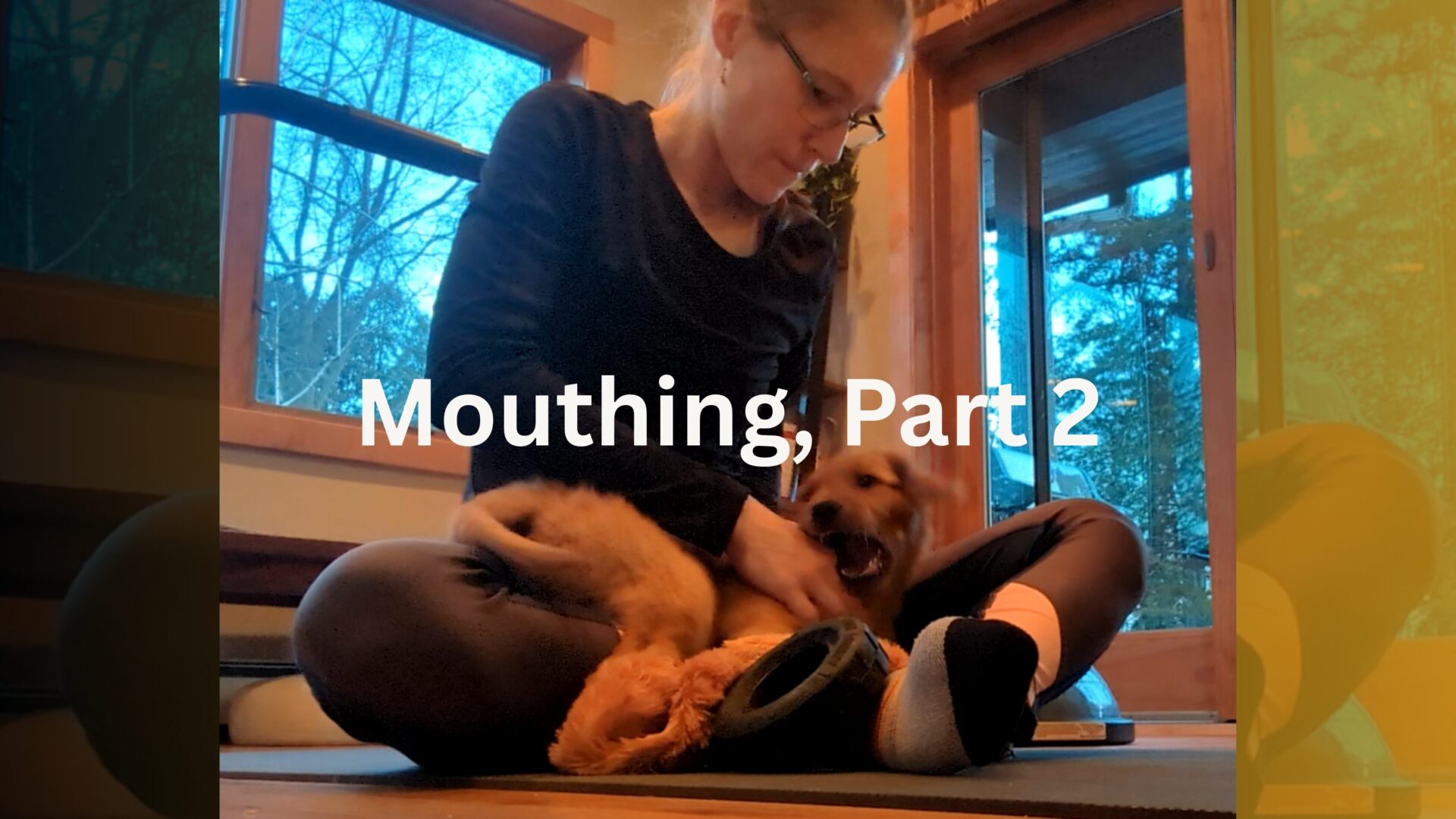
Strategies to Reduce Mouthing
I’m excited to tell you that you have many strategies available to help reduce mouthing in your pup. Chances are that you’ll need a combination of strategies in order to make a dent in this natural, and therefore very common, behavior.
🐕 Key takeaway: Even though mouthing is normal for dogs, most people don’t enjoy it—and teaching polite alternatives makes life easier for everyone.
1. Let Them Eat Cake (AKA Let Them Chew)
The easiest recommendation to help reduce problem mouthing is to increase their ability to put their appropriate mouth on things. This will likely mean getting a bunch of different toy options and letting your dog choose their chews. I would recommend trying all of the following chew toy types to see what your dog prefers:
- Hard chews (food), such as braided bully sticks or cow hooves.
- Moderate chews (food), such as cow snouts, cow or lamb ears, beef cheeks, or beef hide rolls
- Hard chew (non-food), such as Benebones, although note that some vets are concerned about damaging teeth on hard toys
- Wood chews, such as Gorilla chews or coffee wood dog chews
- Rubbery chews, such as West Paw, Goughnuts, or Benebone
- Soft, plush toys
- Ropes, which your dog may want to chew, tug on, or run around with
- Food-fillable toys, such as West Paw topples and Kongs
Also, studies have shown that dogs do get bored of their toys after 1-3 days, so make sure to rotate the chews out every day or so (Wells, 2004). Giving dogs good outlets for their mouths is one of the simplest ways to reduce mouthing.
2. Ensure Your Dog’s Needs are Being Met
Ensuring your dog’s needs are met is your first step toward reducing mouthing. Most dogs’ basic needs are met, but many still have unmet behavioral needs. Walks are helpful, but they often don’t meet the physical and behavioral needs of younger dogs. Many dogs benefit from opportunities to run, play intensely, and use their mouths appropriately during the day.
🐕 Key takeaway: Many mouthing problems aren’t training problems—they’re unmet physical, social, or sleep needs.
Physical outlets
If your dog is social, playing with other well-socialized dogs can be an excellent outlet for mouthing and other high-energy behavior. This allows them to run at full speed and use their mouths (politely) with other dogs, which often reduces mouthing on people.
If your dog is not dog-social, consider renting a fenced-in space where they can run freely. A less ideal option is taking them to a park on a long leash and allowing them to run around while you monitor safety.
Social interaction with you
Many dogs also benefit from direct interaction with their humans. After a full day of work it can be tempting to relax, but meeting your dog’s need for attention and play can significantly reduce mouthing. This can mean spending 20–45 minutes of undivided time together, engaged in play or other activities.
Adequate sleep
Many young dogs don’t get enough sleep and become overtired and cranky—much like toddlers. Pay attention to how much sleep your dog gets on an average day.
Puppies 8–16 weeks old often need 18–20 hours of sleep per day, and even dogs 6–12 months old typically need 14–16 hours daily.
Alternative play outlets
My colleague Leann Boucha, MEd, CBCC-KA, FDM of Sidekick Dog Training recently introduced me to an idea from Kim Brophey called the “Karl Hack.” This involves giving puppies and young dogs large stuffed animals or life-sized fake dogs to wrestle with (Brophey, 2022). For dogs without many dog friends, these “fake play partners” can help them express zoomies and mouthing behaviors appropriately, reducing the likelihood that they direct those behaviors toward you.
End of Part 2
In Part 3, we’ll look at how to use management and training strategies to teach dogs more appropriate ways to interact with people.
Note: This blog about strategies for managing mouthing in dogs is part of a 3-part series. If you missed Part I, you can read it here.
References
Brophey, K. (2022). The Karl Hack. Family Dog Mediation.
Oxley, J. A., Christley, R., & Westgarth, C. (2019). What is a dog bite? Perceptions of UK dog bite victims. Journal of Veterinary Behavior, 29, 40–44.
Waite, M. R., Harman, M. J., & Kodak, T. (2021). Frequency and animal demographics of mouthing behavior in companion dogs in the United States. Learning and Motivation, 74, 101726. Published online by Science Direct.
Wells, D. L. (2004). The influence of toys on the behaviour and welfare of kenneled dogs. Animal Welfare, 13(3), 367–373. Published online by Cambridge University Press.